Euro Roadtrip with Kids 2026 Summary: What, Where, How Much?
Updated: Oct 25
1,059 miles, four countries, ten days, five people and £3,669.99. Was our European road trip cheaper than a traditional summer holiday? And would we do it again?
If you'd told me at the beginning of 2026 that we'd spend ten days of the summer holidays driving around northern Europe, exploring medieval cities, squeezing through caves, visiting war museums, riding rollercoasters and watching a solar eclipse on a Dutch beach, I'd have been absolutely delighted. I just wouldn't have believed we could afford it!
After an extraordinarily difficult start to the year, and with the cost of family holidays seemingly getting more ridiculous every time I looked, we'd all but written off the idea of going abroad.
Then a last-minute boost of work gave us a some holiday money to play with, and Andrew suggested we revisit something we'd enjoyed before: Eurocamp.
A few evenings of frantic research later, we'd somehow assembled a ten-day itinerary through France, Belgium, Luxembourg and the Netherlands, with four different types of accommodation, two big holiday parks, a birthday eclipse and an awful lot of driving.
We'd originally hoped to spend less than £3,000. As it turned out, the final bill was a bit higher than I'd anticipated, partly because some of the activities went unbudgeted (nearly £80 for Bastone war memorial and museum!) and partly because we deliberately splashed out for our youngest fifth birthday.
But even at £3,669.99 for five people, it was considerably cheaper than many of the conventional summer holidays we'd been looking at – and we absolutely got more out of it.
This is the final instalment of our European road trip series, bringing together the complete route, accommodation, spending breakdown, meal planning, practical tips and everything we learned along the way.

Our European road trip at a glance
Our trip | |
Dates | 7–16 August 2026 |
Travellers | 2 adults, 3 children |
Countries | France, Belgium, Luxembourg and the Netherlands |
Distance driven | 1,059 miles |
Transport | Our own Seat Alhambra and LeShuttle |
Accommodation | Hotels, holiday parks, chalets and an Airbnb |
Total recorded spend | £3,669.99 |
Cost per person | £734 |
Cost per person per day | £73.40 |
We managed to squeeze an extraordinary amount into ten days without spending every waking minute travelling.
And, perhaps more importantly, we discovered that some of our favourite days were the ones where we didn't do very much at all.
Our ten-day European road trip itinerary
We deliberately planned a mixture of sightseeing and holiday-park downtime.
The first half would involve most of the driving, history, hiking and exploring. The second half would be a proper family holiday, with swimming pools, theme parks and the beach.
That was the theory, anyway.

Our original itinerary was a bit more intense that what we actually followed through with – we don’t often deviate from a plan but I’m glad we did. We quickly discovered that the holiday parks were far too nice to abandon at every opportunity, and that exploring the Mullerthal region in Luxembourg was worth considerably more time than we'd allocated.
So we changed our plans.
One of the best things about a self-drive road trip is that you can actually do that.
Here's how our ten days eventually unfolded.
Days 1–2: Dunkirk, Ghent and Bastogne
We started with LeShuttle to Calais, followed by a visit to Dunkirk's Operation Dynamo Museum and a fantastic afternoon exploring Ghent.
Ghent was one of the prettiest cities I've visited. We took a canal boat tour, ate enormous quantities of Belgian waffles and chips, and followed a street-art trail with the kids.
The following day we visited the Bastogne War Museum, explored the Easy Company foxholes at Bois Jacques and crossed into Luxembourg.
Days 3-4: Luxembourg, the surprise gem
Luxembourg was probably the biggest surprise of the entire trip.
We'd originally thought of it as a convenient stop between Belgium and the Netherlands (and another country ticked off the list), but ended up completely falling in love with the place.
We spent a wonderfully relaxing day at Hu Birkelt holiday village and exploring a free barefoot woodland trail near Medernach.
The following day was rather more adventurous: the famous Schiessentümpel waterfall, pitch-black sandstone passages on the Kuelscheier hiking route, the ancient Hohllay caves and the chairlift overlooking Vianden Castle.
All in temperatures exceeding 30°C.
We were absolutely exhausted, but it was brilliant – this is the reason we abandoned Luxembourg City and Aachen – too hot for cities when we had a paid pool here.
Day 5: A favourite in Sint Anthonis
After given up our plans to visit Aachen, we headed into the Dutch countryside for an overnight stop at Ardoer Camping De Ullingse Bergen.
This was supposed to be little more than somewhere convenient to sleep.
Instead, it turned out to be one of the nicest family campsites we've ever stayed at.
We had a gorgeous chalet, swimming pools, pedal go-karts, playgrounds, freshly baked croissants and a wonderfully peaceful private garden.
The kids even went off exploring the campsite by themselves for almost an hour, while Andrew and I sat drinking cider and reading in the sunshine.
Unprecedented.
Days 6–9: Duinrell, Wassenaar and a birthday eclipse
Our final proper destination was Duinrell, a holiday park near The Hague with an entire theme park and two massive adventure pools included in the accommodation price.
Four nights of rollercoasters, swimming pools, water slides, beaches and generally doing whatever we fancied.
And, most importantly, Willow celebrated her fifth birthday by watching a partial solar eclipse from Wassenaar Beach.
She'd spent months proudly telling everyone, "I'm having an eclipse for my birthday!"
I think that might be one of my favourite memories of the entire trip.
Day 10: Bruges and the very long journey home
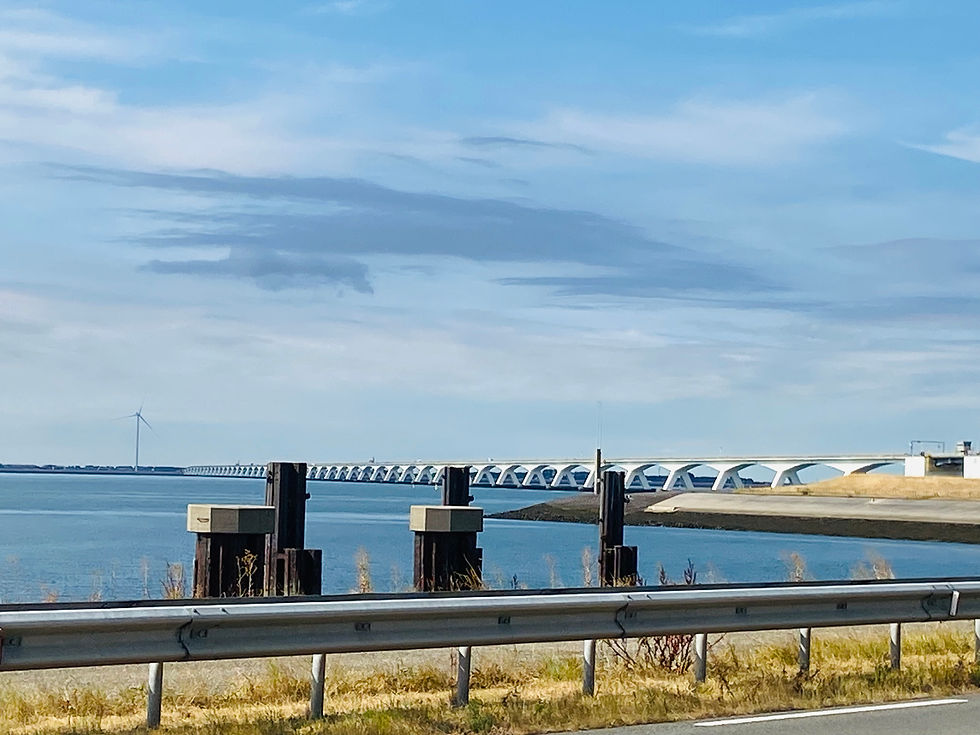
We took the scenic route through the reclaimed Dutch landscapes of Zeeland, crossed into Belgium and spent a lovely afternoon wandering around Bruges.
Then LeShuttle rather spoiled our otherwise remarkably successful run by delaying our return crossing for several hours.
We finally got home at around half past midnight.
At least we subsequently received a £135 voucher towards another crossing, which I'm sure we'll find a use for!
How much did our ten-day European road trip actually cost?
Now for the important bit.
As ever, I kept a spreadsheet of our accommodation bookings and spending, and after the holiday I went through our bank transactions to work out what we'd really paid.
In contrast to literally every other trip from Billund Denmark, to Rome in half term, from Finnish Lapland to 3-months in Central America – this trip represents the first time we have overspent!
Oops.
When looking at why we over spent there are two clear reasons. The first is because I just couldn’t give a ****. The multiple bereavements and desire to live life to the max won me over more than my usual thrifty attitude. Secondly there were some expenses we literally didn’t budget for (and this shows just how stressed I was/am as I’ve not really done this before) – I didn’t factor in the chairlift or museum costs into the budget, among 1-2 other bits.
Our final recorded total came to: £3,669.99 for all five of us.
That's £734 per person, or £73.40 per person per day, including accommodation, transport, food, activities and everything else recorded in our spending tracker.
It isn't an insignificant amount of money, obviously.
But when we'd originally been looking at conventional summer holidays in Spain, Greece and elsewhere, we were seeing prices of £6,000 or more for a family of five, often before factoring in all the food, activities and other spending.
Against those alternatives, our little road trip felt like exceptionally good value.
Where did the money go?
Spending category | Total | Percentage |
Accommodation | £2,268.13 | 61.8% |
Transport | £688.64 | 18.8% |
Food shopping | £336.34 | 9.2% |
Activities and attractions | £250.70 | 6.8% |
Eating out | £108.80 | 3.0% |
Miscellaneous | £14.39 | 0.4% |
Souvenirs | £2.99 | 0.1% |
Total | £3,669.99 | 100% |
The most striking thing is that accommodation and transport accounted for more than 80% of our total holiday expenditure.
Once we'd paid for somewhere to sleep and a way of getting there, we actually spent relatively little on the rest. Shame Europe is so expensive to sleep and travel really! We could have made this a fair bit cheaper without the Sint Anthonis splurge.
We spent just £250.70 on activities and attractions across the ten days.
That included museums, a canal cruise, chairlifts, go-karts and water-park visits, alongside a huge amount of free entertainment.
And our total food spending was only £445.14. For five people. Across ten days!
That's less than £9 per person per day, including all our supermarket shopping and meals out.
I was particularly pleased with that.

In the downloadable transactions vs budget sheet above, I also did analysis by country, which doesn’t tell you a lot as food was purchased in Belgium, fuel in Luxembourg. However, one thing that stands out from this is that Luxembourg, despite its reputation for being expensive, gave us some of our best-value days because so many of the things we did were free.
How we kept food costs down
This was probably the single most successful part of our holiday planning.
Eating out with three children can be painfully expensive, particularly when you're paying tourist prices in European cities or theme parks.
So rather than resign ourselves to €100 restaurant bills every evening, we decided to self-cater almost the entire trip and we took the planning rather seriously (as we usually do!).
Before leaving home, I put together a complete meal plan covering breakfasts, lunches, snacks, dinners and puddings.
We packed dry ingredients, sauces, spices, snacks and other useful bits from home (avoiding falling foul of the post-Brexit ban list), then planned one major supermarket shop in Bastogne before entering Luxembourg, as well as a midway top-up shop to grab additional bits (always more cheese) and things that would expire if we bought them on day 1.
The idea was to avoid repeatedly wandering around unfamiliar supermarkets trying to figure out what to cook, or paying €7 for a tiny jar of something we already had three of at home.
We spent £130.22 on that first major shop, which felt rather painful at the time, but it provided a substantial amount of the food we needed for the remainder of the trip. We still picked up fresh bits and pieces along the way, but we always had a plan.
You can view our food shopping list, including breakdown of buy enroute, bring from home (or both where we knew we would run out) as a tab on the below spreadsheet download.
Our family road trip meal plan

We kept things fairly simple: cereal, toast or pastries for breakfast; sandwiches, wraps and other picnic food for lunch; and easy family dinners such as fajitas, pasta, curry, schnitzel, sausages and BBQ burgers.
We also packed plenty of snacks, which were invaluable during long drives, hikes and the inevitable moments when somebody suddenly became absolutely STARVING.
Our meal plan wasn't followed perfectly, of course.
Some days we ate out, some meals were moved around, and some accommodation was less well equipped than we'd anticipated. Duinrell, for example, had no oven, which nearly scuppered our planned pizza dinner. But having a plan meant we could adapt without constantly starting from scratch and swap days around with ease.
Download our actual meal plan, shopping list and packing checklist
I've made a public version of the spreadsheet we used to organise the trip, including the full meal plan, food shopping list, packing checklist and a rough (not comprehensive) pre-departure to-do list.
It's completely editable, so you can adapt it for your own holiday.
I would absolutely recommend doing this if you're planning a multi-stop self-catering holiday. It takes a bit of work before you leave, but it saves an enormous amount of money, time and hassle once you're away. And perhaps most importantly, it means you don't have to spend your precious holiday evenings arguing about what's for dinner, or even thinking about it tbh!
Transport
This was our first European road trip using our own car rather than flying and hiring something at the other end - and I loved it.
Our eight-seater Seat Alhambra isn't exactly a glamorous touring vehicle, but it was perfect for this sort of holiday and stupidly efficient on the motorways.
We had plenty of room for all five of us, our luggage, bedding, food, games, beach equipment and various other things that would have been impossible or prohibitively expensive to take on a plane.
The kids could spread out, Andrew and I could share the driving, and we could stop whenever something interesting caught our attention.

We also didn't have to worry about car hire, excess insurance, luggage allowances or the cost of transporting five people to and from airports.
We spent £97.14 on fuel during the trip, which I was rather delighted with considering we'd driven 1,059 miles and we returned to £2.00 per litre of diesel when we returned!
There is an important caveat here: we left home with approximately three-quarters of a tank of diesel, so that £97.14 isn't the full cost of the fuel consumed over the holiday.
It's simply what we spent buying fuel while we were away – however – we deliberately chose to fill out in Vianden because we were well off the tourist/motorway trail and it was cheaper than the neighbouring cities.
We also spent £44.97 on parking – a not insignificant amount – but with several destinations offering free parking, particularly in Luxembourg.
And we managed to avoid substantial toll charges by choosing our routes carefully.
I did find the Dutch speed limits and road signage a little baffling at times, particularly the motorway limits that change depending on the time of day.
But the roads were generally excellent, the traffic remarkably light and the driving much more pleasant than I'd anticipated.
LeShuttle
Our return LeShuttle booking cost £526.
That's a significant chunk of the budget, but when you divide it between five people, add in the freedom of having our own car and consider the cost of flights and hire cars, it made sense for us.
The outward journey was brilliant. We arrived early, were offered an earlier train and sailed through without any problems.
The return journey was rather less successful, with several hours of delays at Calais.
However, after contacting LeShuttle, we were awarded a £135 voucher towards a future booking, valid for a year.
I've kept the original £526 in our holiday costs because the voucher isn't a cash refund, but it's a nice little incentive to do another trip!
Our favourite ways to save money on a European road trip
Looking back, there were a few decisions that made an enormous difference to the overall cost.
1. Choose accommodation with activities included.
Hu Birkelt had swimming pools, sports facilities, games areas and plenty to keep the kids entertained.
Duinrell included an entire theme park with our accommodation.
That meant we could spend whole days having fun without buying separate attraction tickets.
Do check the small print, though. Duinrell's Tiki Pools were an additional expense for Eurocamp guests, and we spent more than £100 on swimming during our stay.
2. Make the most of free attractions.
Some of our favourite experiences cost absolutely nothing.
The barefoot trail near Medernach, the waterfall at Schiessentümpel, the sandstone caves, woodland walks, beautiful beaches, city sightseeing and random playground stops were all fantastic.
Luxembourg was especially good for this.
3. Take packed lunches.
This sounds obvious, but it always saves us a fortune – and over the years we’ve definitely saved enough to afford another holiday!
We ate picnics in museum grounds, beside streams, in woodland clearings, on beaches and during long journeys. And, generally speaking, those were much nicer places to eat than an overpriced tourist restaurant anyway.
4. Stay outside expensive city centres.
We couldn't find affordable accommodation in central Ghent for five people, so we stayed around fifteen minutes away instead.
Our overnight stop in rural Sint Anthonis was also much nicer and better value than the city accommodation we'd originally considered.
5. Don't feel obliged to pay for everything.
We were quite happy to admire Vianden Castle from the chairlift rather than paying for another lengthy attraction visit.
And we spent an entire afternoon at Hu Birkelt doing absolutely nothing that cost money.
Sometimes the best way to save money is simply to stop trying to fill every hour.
What we'd do differently next time
As much of a cop-out answer as this is – pretty much nothing! I jest, here are a few:
One thing I might have done better was check accommodation facilities more carefully
Not every self-catering chalet is equipped the same way. We know this.
We had accommodation with dishwashers, ovens, air conditioning and beautiful gardens and accommodation with virtually none of those things.
I would definitely check kitchen facilities, bed sizes, air conditioning, fans, Wi-Fi and any additional swimming-pool charges before booking again. I took Wi-Fi inclusion for granted in the year 2026.
…and perhaps pack a universal sheet that fits whatever bizarre European mattress size we encounter next.
Don't underestimate the heat
We travelled during a particularly fierce European heatwave, with temperatures reaching 38°C.
We'd packed plenty of water bottles, sunscreen and lightweight clothing, but there were days when it was simply too hot to do everything we'd planned.
The ability to retreat to a pool, shaded forest or air-conditioned car was invaluable.
I certainly wouldn't plan a full day of exposed city sightseeing in those temperatures if I could avoid it.
Would we do another European road trip?
Without hesitation.
In fact, I think this trip has made me even more enthusiastic about exploring Europe by car.
We managed to see four countries in ten days, but we never felt as though we were constantly packing and unpacking or sitting in the car.
The longest individual drive was under three hours, and most journeys were considerably shorter.
We found extraordinary places we'd barely heard of before leaving home, and the kids had a wonderful mixture of history, adventure, swimming, independence and completely ordinary family fun.
Some of the things I remember most fondly aren't the major attractions at all.
They're sitting beside a stream eating our packed lunch after squeezing through a pitch-black cave.
Watching the kids run off to explore a Dutch campsite together.
Sitting on a beach while they dug holes in the sand.
Driving through the beautiful reclaimed landscapes of Zeeland.
And standing together on Wassenaar Beach, wearing ridiculous eclipse glasses, celebrating Willow's fifth birthday.
After everything we'd been through earlier in the year, those moments felt particularly precious.
We didn't get to Luxembourg City, Aachen or Maastricht.
But rather than feeling disappointed, I'm rather pleased we've left ourselves a reason to go back.
And given that we now have a £135 LeShuttle voucher burning a hole in our pockets, who knows?
Perhaps we'll be back sooner than we think.
Ten days, 1,059 miles, four countries, five people and £3,669.99.
Not quite the sub-£3,000 holiday I'd originally imagined.
But worth every penny.


Comments